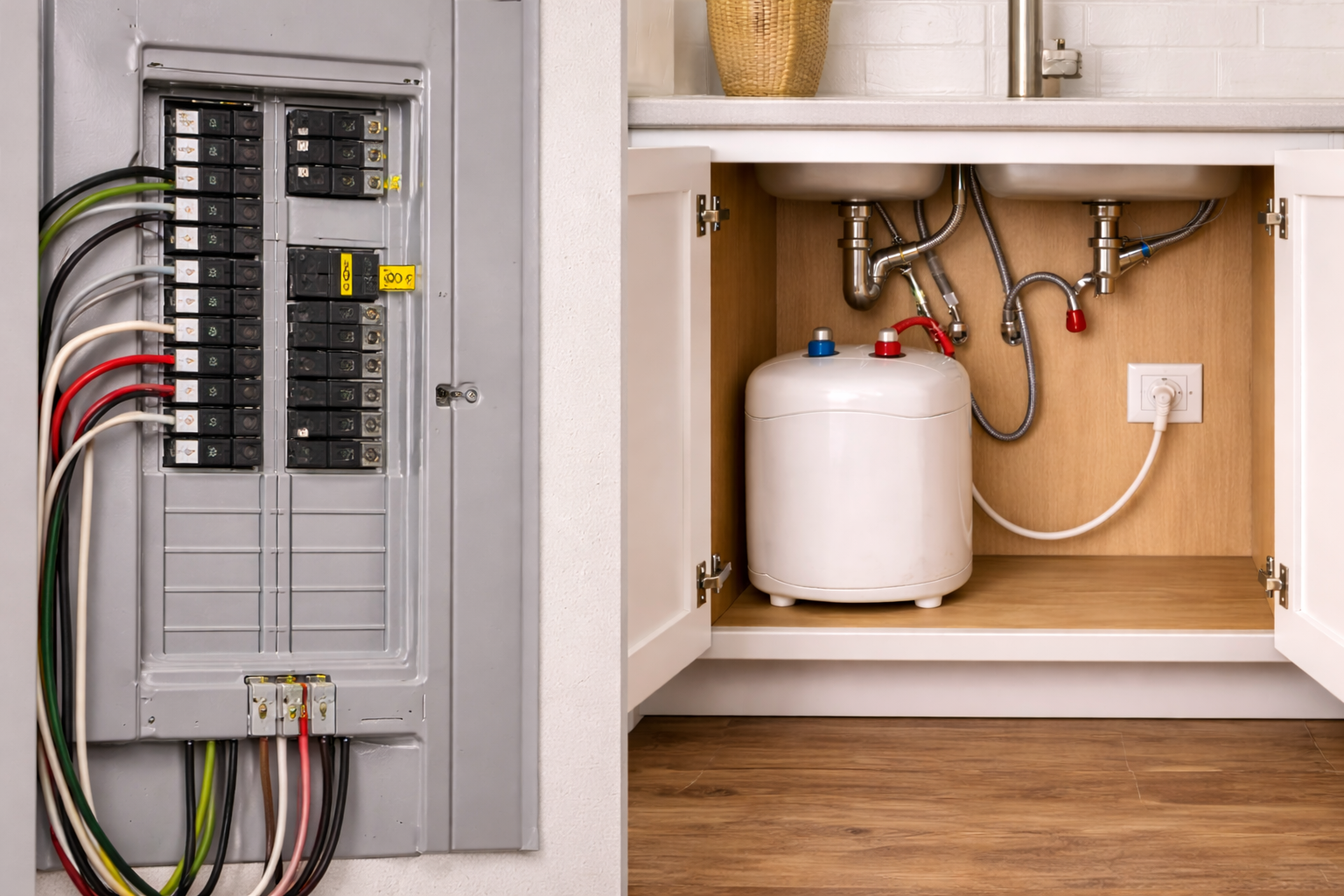
Whether an under-sink water heater needs a dedicated circuit depends on the unit’s voltage, amperage draw, and what else is connected to the same electrical line.
In many homes, small mini-tank units can run on an existing circuit, while larger mini-tank and most tankless systems require a dedicated circuit for safe and reliable operation.
Quick Answer
Small 120V mini-tank units may work on an existing circuit if the load is low. However, tankless units and higher-power systems almost always require a dedicated circuit.
For full electrical context, see Electrical Requirements for Under-Sink Water Heaters.
What Is a Dedicated Circuit?
A dedicated circuit is an electrical line that serves only one appliance, with no other devices sharing the breaker.
This helps:
- Prevent overloads
- Reduce breaker trips
- Ensure stable performance
Appliances with heating elements often benefit from dedicated circuits because they draw sustained power.
Mini-Tank Units
Many 2.5- to 4-gallon mini-tank models:
- Operate on 120V
- Draw around 10–15 amps
- May plug into a standard outlet
However, a plug-in design does not automatically mean a dedicated circuit is unnecessary.
If the same circuit also powers:
- Garbage disposal
- Dishwasher
- Microwave
- Other kitchen appliances
The total load may exceed the breaker capacity.
If you are unsure about outlet compatibility, see Can You Plug an Under-Sink Water Heater Into a Standard Outlet.
Tankless Units
Tankless under-sink water heaters typically:
- Draw higher amperage
- May require 240V
- Usually require a dedicated circuit
Because they heat water instantly, they operate at high power when in use. Sharing a circuit in these cases is not recommended.
If you are comparing system types, see Tank vs Tankless Under-Sink Water Heaters: Which Is Better.
How to Determine If You Need a Dedicated Circuit
To decide whether a dedicated circuit is required:
- Check the manufacturer’s installation manual
- Confirm the unit’s amperage rating
- Review the breaker size for the existing circuit
- Consider what else is powered on that circuit
If installation complexity is unclear, see Can You Install an Under-Sink Water Heater Yourself.
Code and Safety Considerations
Local electrical codes may require:
- Dedicated circuits for fixed appliances
- GFCI protection
- Proper breaker sizing
Even if a unit can technically share a circuit, code requirements may override convenience.
When a Dedicated Circuit Is Recommended
A dedicated circuit is generally recommended when:
- Installing a tankless unit
- Installing a 240V system
- The existing circuit already powers multiple appliances
- Breaker trips have occurred
Providing adequate electrical capacity improves reliability and reduces risk.
How Circuit Requirements Affect Heater Choice
Electrical limitations often determine which type of heater is practical.
If your setup is limited, a small mini-tank unit may be the easiest option. If your electrical system can support higher loads, a tankless unit may provide better long-term performance.
To match heater size to your needs, see What Size Under-Sink Water Heater Do I Need.
You can also compare suitable models here: Best Under-Sink Water Heaters.
Quick Summary
- Small mini-tank units may work on existing circuits if load is low
- Tankless and higher-power units typically require dedicated circuits
- Always check electrical capacity and local code before installation
Once you confirm your electrical setup, you can explore compatible models here: Best Under Sink Water Heaters.
Bottom Line
Some under-sink water heaters can operate without a dedicated circuit, but many require one for safe and reliable use.
The decision depends on voltage, amperage, and total circuit load.
Matching the heater to your electrical setup ensures proper performance and avoids installation issues.