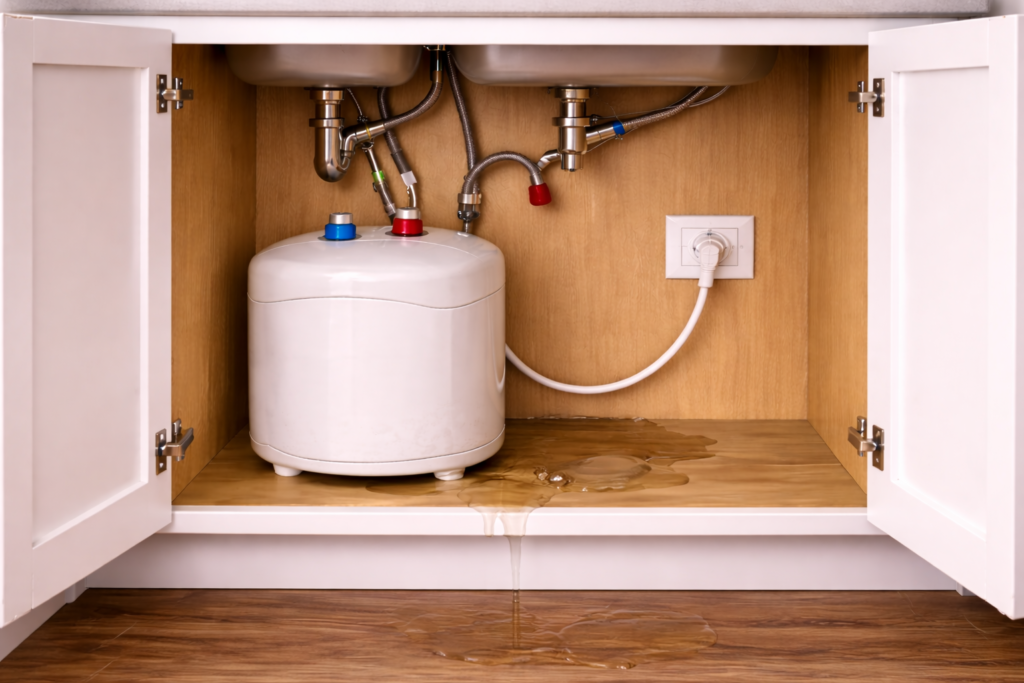
If your under-sink water heater is leaking, the source may be a loose connection, a pressure issue, or internal tank damage. Identifying the exact location of the leak is the first step.
Small drips are often repairable. Tank corrosion or structural failure usually requires replacement.
If you’re unfamiliar with how these systems connect, review Plumbing Requirements for Under-Sink Water Heaters
Step 1: Identify Where the Leak Is Coming From
Common leak points include:
-
Supply line connections
-
Temperature and pressure (T&P) relief valve
-
Drain plug
-
Tank body
-
Internal fittings
Dry the area thoroughly and observe where moisture reappears.
Loose or Damaged Supply Lines
Leaks at fittings are common after installation or over time.
Check for:
-
Loose threaded connections
-
Worn washers
-
Damaged braided hoses
Turn off the water supply before tightening or replacing fittings.
For installation guidance, see Can You Install an Under-Sink Water Heater Yourself?
Pressure Relief Valve Discharge
Occasional dripping from the pressure relief valve may indicate:
-
Excessive water pressure
-
Thermal expansion
-
Faulty valve
Mini-tank units typically include a T&P valve. Improper installation can cause leakage.
For more detail, see Do Under-Sink Water Heaters Need a Pressure Relief Valve?
Tank Corrosion
If water appears to be leaking directly from the tank body, corrosion may be the cause.
Signs of internal tank failure:
-
Rust-colored water
-
Moisture along tank seams
-
Persistent dripping unrelated to fittings
When the tank itself leaks, replacement is usually the only solution.
To understand expected lifespan, see How Long Do Under-Sink Water Heaters Last?
Tankless Unit Leaks
Tankless models do not store water, but leaks may occur at:
-
Inlet/outlet connections
-
Internal seals
-
Flow sensors
If you’re comparing system types, review Tank vs Tankless Under-Sink Water Heaters: Which Is Better?
When to Turn Off the Unit
If you notice:
-
Active dripping
-
Water pooling in the cabinet
-
Electrical components getting wet
Turn off:
-
The water supply
-
The electrical breaker
Then inspect the source safely.
When to Replace Instead of Repair
Replacement may be appropriate if:
-
The tank is rusted
-
Internal corrosion is visible
-
The unit is near end of lifespan
-
Repair cost approaches replacement cost
Quick Summary
Under-sink water heater leaks most commonly occur at fittings or valves. These are often repairable. Leaks from the tank body usually require full replacement.
Prompt inspection helps prevent cabinet damage and electrical hazards.