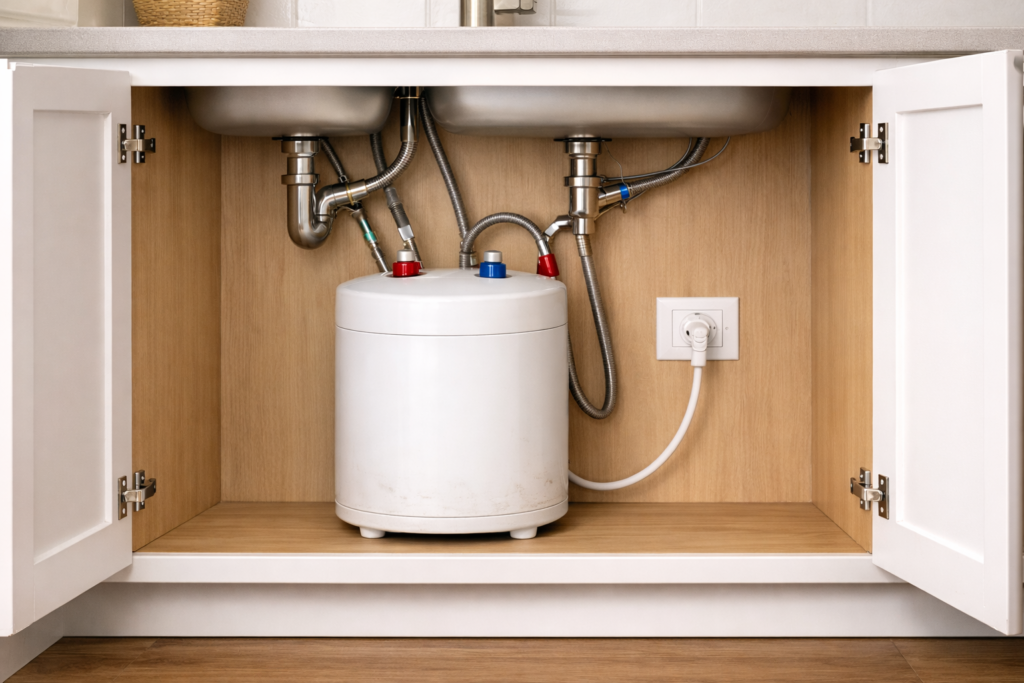
An under-sink water heater makes sense when hot water takes too long to reach a specific sink, or when you want more convenience at a single fixture.
These systems are designed to solve a localized problem — not to replace a whole-house water heater.
If you’re new to how they work, start with What Is an Under-Sink Water Heater and How Does It Work?
Long Wait Times for Hot Water
One of the most common reasons to install an under-sink heater is excessive wait time.
If you regularly:
-
Run the tap for 20–60 seconds waiting for hot water
-
Waste water while waiting
-
Experience inconsistent temperature at a remote sink
A point-of-use heater can improve convenience.
Remote or Added Fixtures
Under-sink water heaters are often useful when:
-
A sink is far from the main water heater
-
A new sink was added during renovation
-
A garage, workshop, or laundry sink lacks nearby hot water
Rather than rerouting plumbing from the main system, a small local heater can be simpler.
Light-Demand, Single-Fixture Use
Under-sink heaters are best suited for:
-
Bathroom sinks
-
Light kitchen use
-
Occasional handwashing stations
They are not designed to supply multiple fixtures at once.
If you’re unsure what size would be appropriate, see What Size Under-Sink Water Heater Do I Need?
Supplemental Hot Water
In some homes, an under-sink heater is used as a booster. It provides immediate hot water while the main system’s hot water is still traveling through pipes.
This approach can reduce frustration without replacing the main heater.
If you’re comparing system types, read Tank vs Tankless Under-Sink Water Heaters: Which Is Better?
When It May Not Make Sense
An under-sink water heater may not be ideal if:
-
Hot water delay is minimal
-
Cabinet space is limited
-
Electrical capacity is insufficient
-
You need to supply multiple fixtures
Before installing, review Electrical Requirements for Under-Sink Water Heaters
You should also confirm placement details in Where Should an Under-Sink Water Heater Be Installed?
Cost vs Convenience
These units add:
-
Purchase cost
-
Installation expense
-
Electrical usage
For many homeowners, the decision comes down to convenience and water savings versus added equipment.
If you’re budgeting, see Under-Sink Water Heater Installation Cost Guide
Quick Summary
An under-sink water heater makes sense when a single sink has long hot-water delays or when a remote fixture needs dedicated hot water.
It is most effective as a targeted convenience upgrade — not as a whole-house solution.