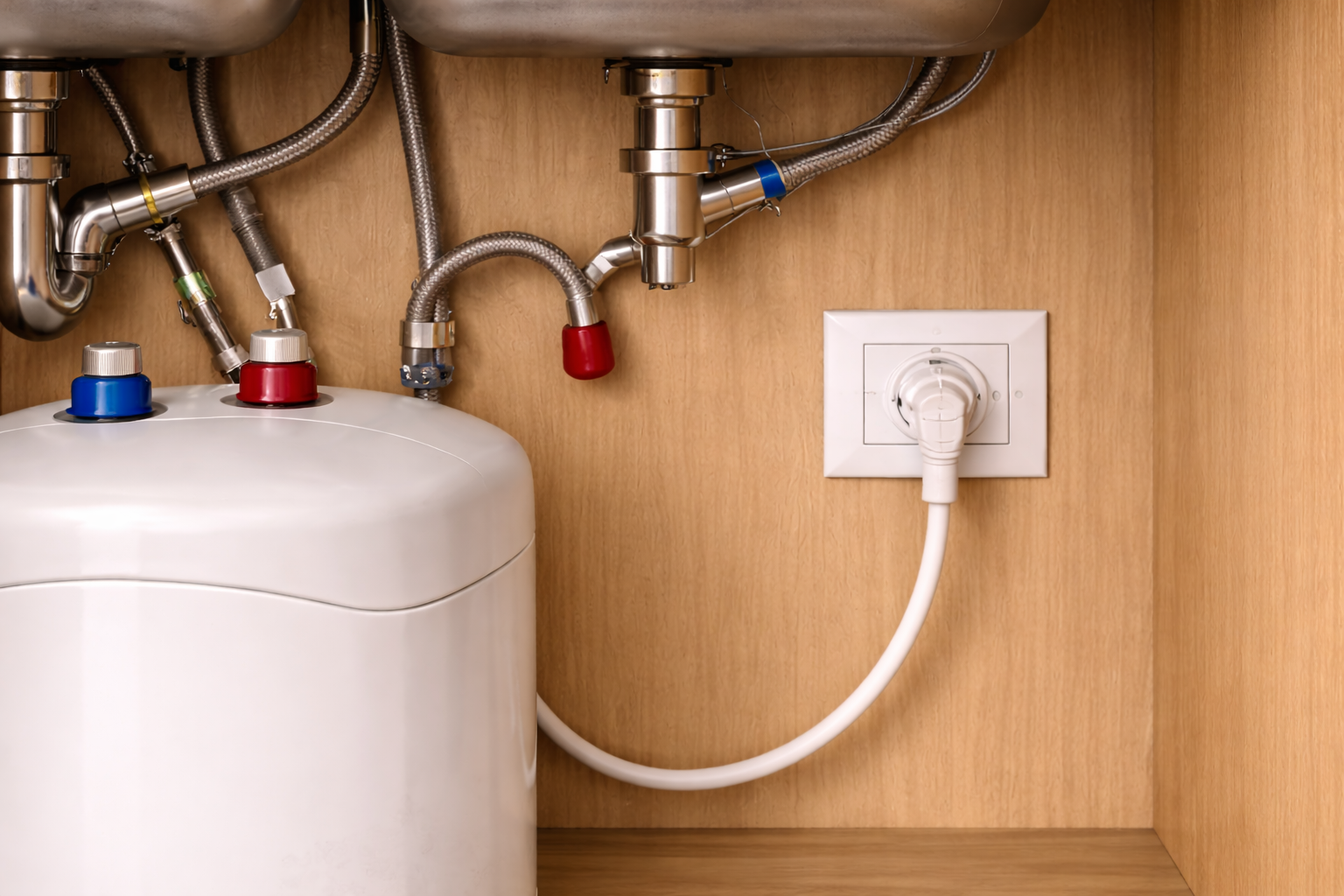
Some under-sink water heaters can plug into a standard household outlet. Others cannot. The answer depends on the unit’s voltage and amperage requirements.
Before assuming compatibility, check the manufacturer’s specifications.
If you haven’t reviewed electrical basics yet, start with Electrical Requirements for Under-Sink Water Heaters
When a Standard Outlet May Be Acceptable
Many small mini-tank under-sink heaters:
-
Operate on 120 volts
-
Draw around 10–15 amps
-
Come with a factory-installed plug
In these cases, the unit is designed to connect to a typical grounded outlet.
However, that does not automatically mean the circuit is suitable.
For guidance on circuit load, see Do Under-Sink Water Heaters Need a Dedicated Circuit?
When a Standard Outlet Is Not Enough
A standard outlet may not be sufficient if:
-
The unit requires 240 volts
-
The amperage draw exceeds breaker capacity
-
The outlet shares a circuit with high-load appliances
-
The manufacturer specifies hardwiring
Tankless under-sink water heaters are more likely to require higher voltage and direct wiring.
If you’re comparing system types, review Tank vs Tankless Under-Sink Water Heaters: Which Is Better?
GFCI Protection
Because under-sink water heaters are installed near plumbing, GFCI protection is often required.
This may mean:
-
A GFCI outlet
-
A GFCI breaker
Local electrical codes determine exact requirements.
Safety Considerations
Before plugging in a unit:
-
Confirm the breaker rating
-
Ensure the outlet is properly grounded
-
Verify that no extension cords are used
-
Avoid overloaded circuits
If you are uncertain about wiring or load capacity, professional evaluation may be appropriate.
For installation overview, see Can You Install an Under-Sink Water Heater Yourself?
Quick Summary
Some mini-tank under-sink water heaters are designed to plug into standard 120V outlets. Tankless and higher-power units often require 240V service or hardwired installation.
Always confirm voltage, amperage, and circuit capacity before plugging in the unit.