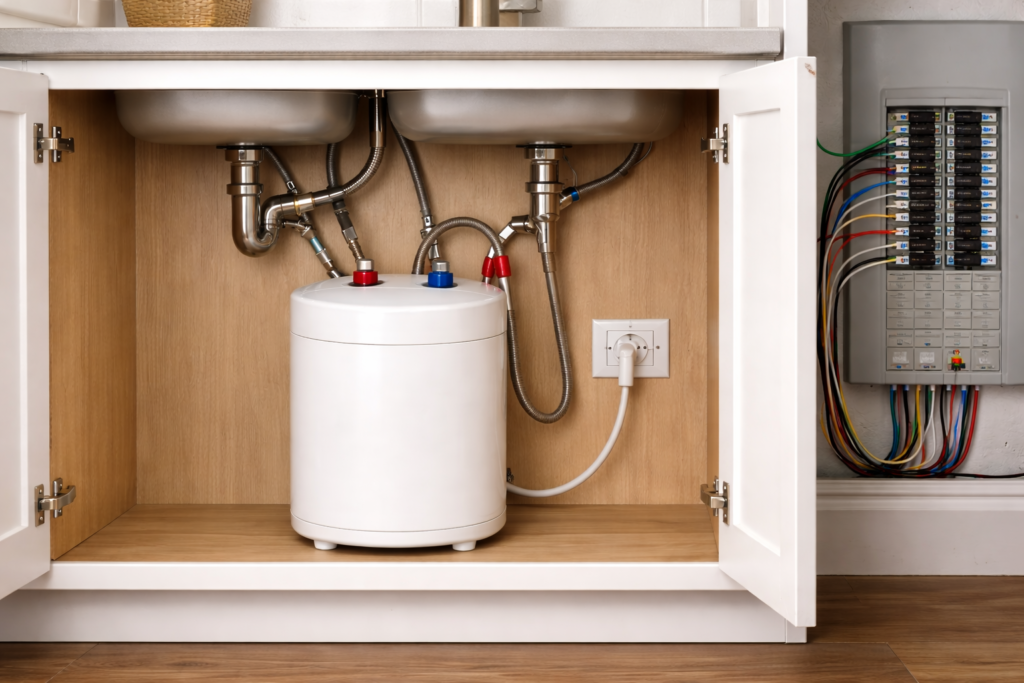
Electrical requirements are one of the most important factors when choosing an under-sink water heater. The power supply must match the unit’s voltage and amperage needs.
Mini-tank and tankless systems have very different electrical demands.
If you’re still comparing system types, read Tank vs Tankless Under-Sink Water Heaters: Which Is Better?
Voltage Requirements
Most mini-tank under-sink water heaters operate on:
-
120 volts (standard household outlet in many homes)
Some larger mini-tank models and many tankless units may require:
-
240 volts
Always check the manufacturer’s specifications before purchasing.
If you’re unsure about outlet compatibility, see Can You Plug an Under-Sink Water Heater Into a Standard Outlet?
Amperage and Circuit Load
In addition to voltage, amperage matters.
Mini-tank units often draw between:
-
10 to 15 amps
Tankless units may draw significantly more — sometimes:
-
20 to 40+ amps depending on model
High-draw tankless units frequently require:
-
A dedicated circuit
-
Heavier gauge wiring
-
A compatible breaker
For more detail, review Do Under-Sink Water Heaters Need a Dedicated Circuit?
Dedicated Circuit Requirements
Many mini-tank units can operate on a properly rated existing circuit. However, this depends on:
-
What else is connected to the circuit
-
The breaker rating
-
Local electrical code
Tankless systems are far more likely to require a dedicated circuit due to higher power draw.
If you’re planning installation, also read Can You Install an Under-Sink Water Heater Yourself?
GFCI and Safety Considerations
Because under-sink heaters are installed near water, electrical protection is critical.
Common safety requirements include:
-
GFCI outlet or breaker
-
Proper grounding
-
Correct breaker size
-
Manufacturer-specified wire gauge
Local building codes may require specific protections, especially in kitchens and bathrooms.
Panel Capacity
Before installing a higher-demand unit, confirm your electrical panel has:
-
Available breaker space
-
Adequate total service capacity
-
Room for circuit upgrades if needed
If your panel is near capacity, adding a tankless unit may require electrical upgrades.
Quick Summary
Mini-tank under-sink heaters typically:
-
Run on 120V
-
Draw moderate amperage
-
May work on an existing properly rated circuit
Tankless units often:
-
Require 240V
-
Draw higher amperage
-
Need dedicated circuits
Matching the unit’s electrical requirements to your home’s capacity is essential for safe operation.