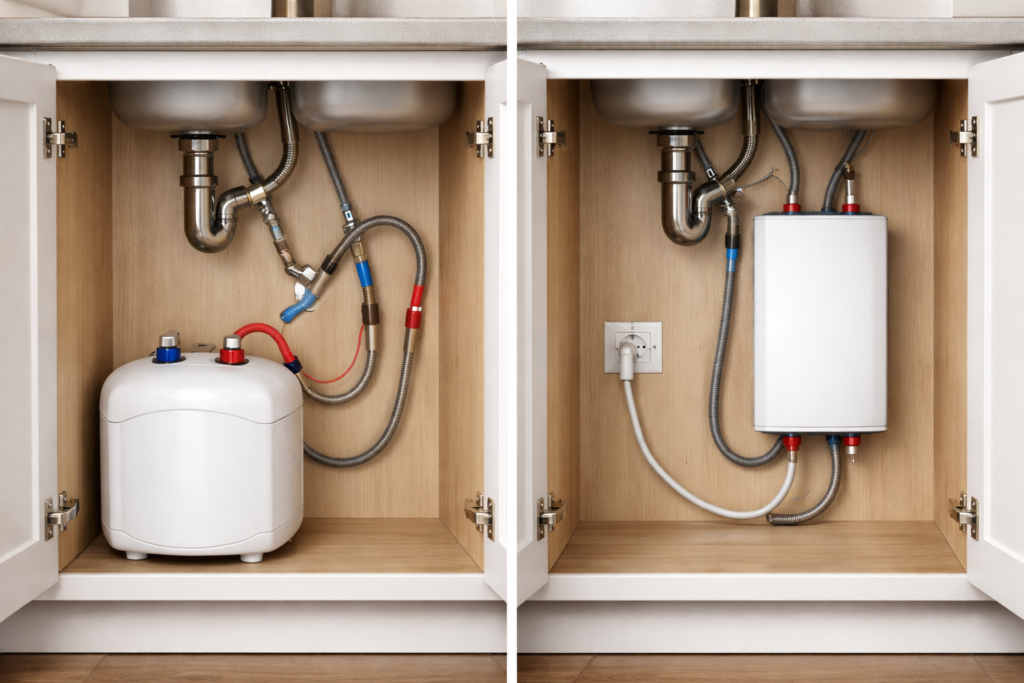
Choosing between a tank and tankless under-sink water heater depends on how the sink is used, how much hot water you need at one time, and what your electrical setup can support.
Both types solve the same problem — long waits for hot water — but they do it in different ways.
If you’re new to these systems, start with What Is an Under-Sink Water Heater and How Does It Work?
How Mini-Tank (Storage) Models Work
Mini-tank units store a small amount of heated water inside an insulated tank. Common sizes range from 2.5 to 7 gallons.
When you turn on the tap:
-
Hot water is delivered immediately from the tank
-
Cold water enters the tank
-
The heating element reheats the new water
These units are simple and predictable. For short uses like handwashing or rinsing dishes, they work well.
If you’re unsure about sizing, see What Size Under-Sink Water Heater Do I Need?
You can also review:
How Tankless (On-Demand) Models Work
Tankless under-sink water heaters do not store water. Instead, they heat water instantly as it flows through the unit.
When you turn on the hot tap:
-
Water begins flowing through the heater
-
The heating element activates
-
Water is heated in real time
There is no stored hot water. As long as the unit can keep up with flow rate, you won’t “run out” in the same way a tank does.
However, tankless units often require more electrical capacity.
Before choosing this option, read Electrical Requirements for Under-Sink Water Heaters
You may also need to consider Do Under-Sink Water Heaters Need a Dedicated Circuit?
Performance Comparison
Mini-Tank Strengths:
-
Immediate hot water
-
Lower electrical demand (many run on 120V)
-
Simple installation
-
Stable temperature for short use
Mini-Tank Limitations:
-
Limited supply
-
Requires recovery time after heavy use
-
Takes up more cabinet space
Tankless Strengths:
-
No stored water limitations
-
Very compact design
-
No standby heat loss
Tankless Limitations:
-
Higher electrical demand
-
May require electrical upgrades
-
Temperature can vary with flow rate
Which Is Better for Kitchens?
For most kitchen sinks, a mini-tank unit is often the simpler and more practical solution. It delivers immediate hot water for short tasks like rinsing dishes or washing hands.
If the sink sees extended hot water use and your electrical system can handle it, tankless may be suitable.
For installation considerations, review Can You Install an Under-Sink Water Heater Yourself?
Which Is Better for Bathrooms?
Bathroom sinks usually have lower hot water demand. In many cases, a small 2.5-gallon mini-tank unit is sufficient.
Tankless units can work, but the added electrical complexity may not always be necessary for light-use applications.
Quick Decision Guide
Choose mini-tank if:
-
You want simple installation
-
You have standard 120V power
-
You use short bursts of hot water
Choose tankless if:
-
You want compact size
-
You need continuous hot water at that sink
-
Your electrical system supports higher load
For a full overview of when these systems make sense, see When Does an Under-Sink Water Heater Make Sense?